Showing posts with label group behavior. Show all posts

Tuesday, November 6, 2018

Striving for a Honeybee Democracy

A revision of an article from August 14, 2017.

Democracy is hard. And slow. And complicated. But if it is done well, it can result consistently in the best decisions and courses of action for a group. Just ask honeybees.

When a honeybee hive becomes overcrowded, the colony (which can have membership in the tens of thousands) divides in what will be one of the riskiest and potentially deadliest decisions of their lives. About a third of the worker bees will stay home to rear a new queen while the old queen and the rest of the hive will leave to establish a new hive. The newly homeless colony will coalesce on a nearby branch while they search out and decide among new home options. This process can take anywhere from hours to days, during which the colony is vulnerable and exposed. But they can’t be too hasty: choosing a new home that is too small or too exposed could be equally deadly.

Our homeless honeybee swarm found an unconventional "branch". We'd better
decide on a new home soon! Photo by Nino Barbieri at Wikimedia.

Although each swarm has a queen, she plays no role in making this life-or-death decision. Rather, this decision is made by a consensus among 300-500 scout bees after an intense “dance-debate”. Then, as a single united swarm, they leave their branch and move into their new home. At this point, it’s critical that the swarm is unified in their choice of home site, because a split-decision runs the risk of creating a chaos in which the one and only queen can be lost and the entire hive will perish. This is a high-stakes decision that honeybees make democratically, efficiently, and amazingly, they almost always make the best possible choice! How do they do that? And how can we do that?

The honeybee house-hunting process has several features that allow them, as a group, to hone in on the best possible solution. The process begins when a scout discovers a site that has the potential to be a new home. She returns to her swarm and reports on this site, using a waggle dance that encodes the direction and distance to the site and her estimate of its quality. The longer she dances, the more suitable she perceived the site to be. Other scouts do the same, perhaps visiting the same site or maybe a new one, and they report their findings in dance when they return. (Importantly, scouts only dance for sites that they have seen themselves). As more scouts are recruited, the swarm breaks into a dancing frenzy with many scouts dancing for multiple possible sites. Over time, scouts that are less enthusiastic about their discovered site stop dancing, in part discouraged by dancers for other sites that head-bump them while beeping. Eventually, the remaining dancing scouts are unified in their dance for what is almost always the best site. The swarm warms up their flight muscles and off they go, in unison, to their new home.
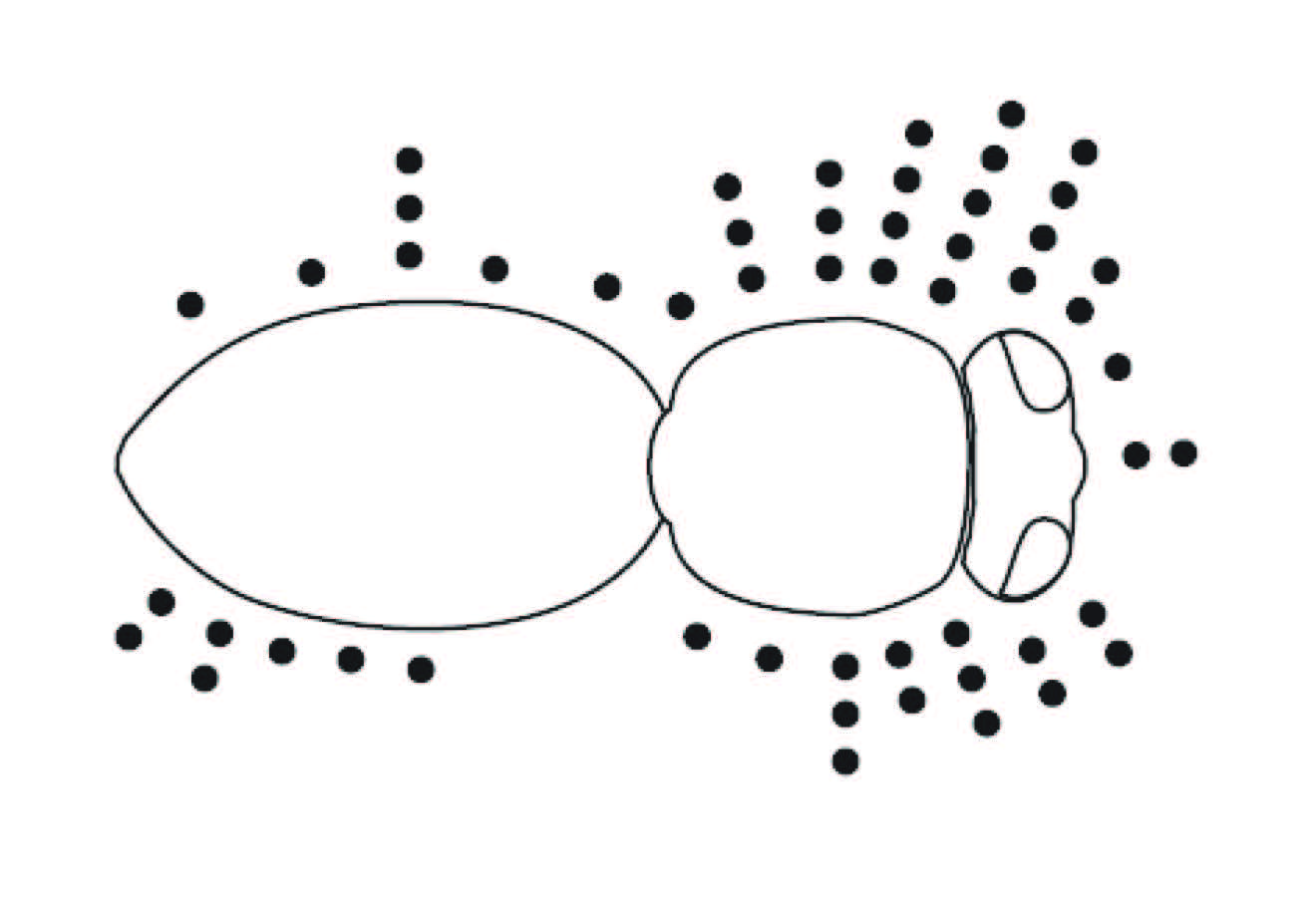
Each dot represents where on the body this dancer was head-bumped by a dancer for a
competing site. Each time she's bumped, she's a little less enthusiastic about her own dance.
Figure from Seeley, et al. 2012 paper in Science.

What can we learn from these democratic experts? As much as I would love to see Congress in a vigorous dance-debate head-butting one another, I don't think that is the take-home message of choice. Tom Seeley at Cornell University has gained tremendous insight into effective group decision-making from his years observing honeybees, which he shares with us in his book, Honeybee Democracy. Tom has summarized his wisdom gained from observing honeybees in the following:

Members of Highly Effective Hives:

1. share a goal

2. search broadly to find possible solutions to the problem

3. contribute their information freely and honestly

4. evaluate the options independently and vote independently

5. aggregate their votes fairly

All of these critical guidelines can be encapsulated with a single objective: The decision-making body needs to objectively consider a range of information from individuals with diverse backgrounds, expertise, and knowledge. We can apply this to our own human decision-making: It means that we all need to vote objectively and honestly and independently. This means casting votes that are consistent with our own information and judgements, even when they are not consistent with the policical party we may align ourselves with. It also means that if you don't agree with the decisions of your School Board, Town Board, City Council, County Legislature, State Legislature, or National Legislature, then your background, expertise and knowledge are likely missing from the deciding body. Yes, you can write and call your representatives and provide them with part of your knowledge, or you can run for office yourself and make people with your background truly included in the decision-making process.

Many feel that our hive has been homelessly clinging to our exposed branch for too long. If we are going to make good, well-informed, effective, and efficient decisions, we need open and respectful communication across diverse backgrounds. Independent thinking and diversity improves the quality of the decisions that affect us all. If honeybees can do it, so can we.


Want to know more? Check these out:

1. Honeybee Democracy by Thomas Seeley

2. Seeley, T., Visscher, P., Schlegel, T., Hogan, P., Franks, N., & Marshall, J. (2011). Stop Signals Provide Cross Inhibition in Collective Decision-Making by Honeybee Swarms Science, 335 (6064), 108-111 DOI: 10.1126/science.1210361

3. List, C., Elsholtz, C., & Seeley, T. (2009). Independence and interdependence in collective decision making: an agent-based model of nest-site choice by honeybee swarms Philosophical Transactions of the Royal Society B: Biological Sciences, 364 (1518), 755-762 DOI: 10.1098/rstb.2008.0277

Tuesday, October 16, 2018

The Smell of Fear

A repost of an original article from October 24, 2012.

Several animals, many of them insects, crustaceans and fish, can smell when their fellow peers are scared. A kind of superpower for superwimps, this is an especially useful ability for prey species. An animal that can smell that its neighbor is scared is more likely to be able to avoid predators it hasn’t detected yet.

Who can smell when you're scared? Photo provided by Freedigitalphotos.net.

“What does fear smell like?” you ask. Pee, of course.

I mean, that has to be the answer, right? It only makes sense that the smell of someone who has had the piss scared out of them is, well… piss. But do animals use that as a cue that a predator may be lurking?

Canadian researchers Grant Brown, Christopher Jackson, Patrick Malka, Élisa Jaques, and Marc-Andre Couturier at Concordia University set out to test whether prey fish species use urea, a component of fish pee, as a warning signal.

A convict cichlid in wide-eyed
terror... Okay, fine. They're
always wide-eyed. Photo by
Dean Pemberton at Wikimedia.

First, the researchers tested the responses of convict cichlids and rainbow trout, two freshwater prey fish species, to water from tanks of fish that had been spooked by a fake predator model and to water from tanks of fish that were calm and relaxed. They found that when these fish were exposed to water from spooked fish, they behaved as if they were spooked too (they stopped feeding and moving). But when they were exposed to water from relaxed fish, they fed and moved around normally. Something in the water that the spooked fish were in was making the new fish act scared!

To find out if the fish may be responding to urea, they put one of three different concentrations of urea or just plain water into the tanks of cichlids and trout. The cichlids responded to all three doses of urea, but not the plain water, with a fear response (they stopped feeding and moving again). The trout acted fearfully when the two highest doses of urea, but not the lowest urea dose or plain water, were put in their tank. Urea seems to send a smelly signal to these prey fish to “Sit tight – Something scary this way comes”. And the more urea in the water, the scarier!

But wait a minute: Does this mean that every time a fish takes a wiz, all his buddies run and hide? That would be ridiculous. Not only do freshwater fish pee a LOT, many are also regularly releasing urea through their gills (I know, gross, right? But not nearly as gross as the fact that many cigarette companies add urea to cigarettes to add flavor).

The researchers figured that background levels of urea in the water are inevitable and should reduce fishes fear responses to urea. They put cichlids and trout in tanks with water that either had a low level of urea, a high level of urea, or no urea at all. Then they waited 30 minutes, which was enough time for the fish to calm down, move around and eat normally. Then they added an additional pulse of water, a medium dose of urea, or a high dose of urea. Generally, the more urea the fish were exposed to for the 30 minute period, the less responsive they were to the pulse of urea. Just like the scientists predicted.

A rainbow trout smells its surroundings.
Photo at Wikimedia taken by Ken Hammond at the USDA.

But we still don’t know exactly what this means. Maybe the initial dose of urea makes the fish hide at first, but later realize that there was no predator and decide to eat. Then the second pulse of urea may be seen by the fish as “crying wolf”. Alternatively, maybe the presence of urea already in the water masks the fishes’ ability to detect the second urea pulse. Or maybe both explanations are true.

Urea, which is only a small component of freshwater fish urine, is not the whole story. Urea and possibly stress hormones make up what scientists refer to as disturbance cues. Steroid hormones that are involved in stress and sexual behaviors play a role in sending smelly signals in a number of species, so it makes sense that stress hormones may be part of this fearful fish smell. But fish also rely on damage-released alarm cues and the odor of their predators to know that a predator may be near. Scientists are just starting to get a whiff of what makes up the smell of fear.

Want to know more? Check these out:

1. Brown, G.E., Jackson, C.D., Malka, P.H., Jacques, É., & Couturier, M-A. (2012). Disturbance cues in freshwater prey fishes: Does urea function as an ‘early warning cue’ in juvenile convict cichlids and rainbow trout? Current Zoology, 58 (2), 250-259

2. Chivers, D.P., Brown, G.E. & Ferrari, M.C.O. (2012). Evolution of fish alarm substances. In: Chemical Ecology in Aquatic Systems. C. Brömark and L.-A. Hansson (eds). pp 127-139. Oxford University Press, Oxford.

3. Brown, G.E., Ferrari, M.C.O. & Chivers, D.P. (2011). Learning about danger: chemical alarm cues and threat-sensitive assessment of predation risk by fishes. In: Fish Cognition and Behaviour, 2nd ed. C. Brown, K.N. Laland and J. Krause (eds). pp. 59-80, Blackwell, London.

Tuesday, September 11, 2018

Exploring How Predators Hunt

By Jon Clark

A "Lion King" in his natural habitat. Photo by Jon Clark.
Predatory animals are a huge obsession for most children at some point. From that picture book about the cool T-Rex to watching “The Lion King” millions of times, we’re fascinated with the kings of the food chain. And let’s be honest, even as adults they’re still pretty neat to us. Why else take a grand safari adventure to see lions and other animals in their natural habitat? So to fuel that curiosity, below is a guide to how predators hunt. It might just help you understand animal movements and behavior for watching wildlife.


The basics of how predators hunt


Predators are, of course, animals that feed on other animals. These predators rely on the flesh of other animals as a resource for their survival and are highly skilled at finding and catching it. Predators sit at the top of a delicate food web, all components of which fit together to keep the environment balanced over time.

Different types of predators have four main hunting strategies for finding their prey. According to an article from Idaho Public Television, they are:

  • Chase: Think of an eagle diving for a mouse. This is chase behavior in predators. This method requires a delicate balance of hunting down food that provides enough energy and nutrition to offset the energy cost of running that food source down.

  • Stalk: For this method, think of an egret or crane standing motionless or walking slowly in water, and then lunging as a tasty morsel goes by. This method is a huge time sink for the animal as it moves from cover to cover getting incrementally closer to it’s prey. It also takes far less energy, however, as only a small burst of speed is required at the end. This means that these predators can often live off of smaller prey. 

  • Ambush: Lion researcher, George Schaller, watched a group of gazelles in the Serengeti. In order to access water, there was a patch of thick brush they would need to cross. As the gazelles entered the brush, Schaller watched as the lions hiding in wait, instantly ambushed and ate one of the gazelles. Due to their long manes and tan color, lions are nearly undetectable in such cover. The ambush requires a great deal of time, as it relies on other animals to wander into the area. For predators that have the patience, the success rates are quite high.

  • Teamwork: Think of wolves working as a pack to take down a deer. This is one of the most exciting ways of how predators hunt. Teamwork allows the animals to pursue large and fast prey, scoring large amounts of food for the group. This is arguably one of the most successful tactics as seasoned hunters can quickly steer their prey in the direction of the other party. Additionally, the energy required for the chase and kill can be dispersed across the collective group. 


Lions on the hunt


One of the coolest and most popular things to see on a safari is a lion in its own natural habitat. This mighty “King of the Jungle” hunts both independently and as part of groups. Lions hunt some of the fastest animals in the world, like the wildebeest, which can run at speeds of 50 mph. Lions themselves are not incredibly fast, so they’ve had to get smart through a variety of hunting strategies.

Because lions are also relatively lazy animals, they tend to eat larger animals – which sustain them for longer periods. These animals include antelopes, zebras and wildebeest.

A lioness. Photo by Jon Clark.

The female lionesses hunt the most often for both themselves and for the males. A lioness will stalk from cover to cover to get close to the prey animal, and then pounce at the last minute. Their prey usually has slower reaction times, so this is a solid method. If the prey sees them, the lion will act innocent by sitting up and staring off into the distance, as if to say, “I wasn’t doing anything.”

Another method lions use is to find a bush near where the prey goes often, like a watering hole, and wait until they can strike. Lions have been known to actually nap while awaiting their deadly ambush.

To catch large or fast prey, lions leverage their group numbers to help each other cut off the escape of fleeing prey. When lions decide to hunt in pairs and groups their success rate goes up from about 18 percent to 30 percent while hunting alone and in daylight, according to the African Lion & Environmental Research Trust.

When hunting in groups, lions stalk in a pattern to encircle the prey. Then some attack, driving the prey to other waiting lions. As the prey animal tires from the constant running, one or two lionesses will try to jump on the back of the animal or hang by their claws from a zebra's or gnu's or buffalo's back. This certainly makes it very hard for the poor animal to run away from the next lion, who goes for the throat to complete the hunt. It’s one of the smartest and most effective ways for how predators hunt.

Hungry cubs waiting for lunch. Photo by Jon Clark.

Lions are known for their advanced hunting skills and have mastered the art of teamwork in all of their hunting strategies, including chasing, stalking, and ambushing their prey. Embarking on an African safari will be your best chance to experience these master hunters in real life.

Tuesday, April 3, 2018

Animal Mass Suicide and the Lemming Conspiracy

A repost of an original article from April 4, 2012.

Ticked off Norway lemming doesn't like gossip!
Photo from Wikimedia Commons by Frode Inge Helland 
We all know the story: Every few years, millions of lemmings, driven by a deep-seated urge, run and leap off a cliff only to be dashed on the rocks below and eventually drowned in the raging sea. Stupid lemmings. It’s a story with staying power: short, not-so-sweet, and to the rocky point.

But it is a LIE.

And who, you may ask, would tell us such a horrendous fabrication? Walt Disney! Well, technically not Walt Disney himself… Let me explain:

The Disney Studio first took interest in the lemming mass suicide story when, in 1955, they published an Uncle Scrooge adventure comic called “The Lemming with the Locket” illustrated by Carl Barks. In this story, Uncle Scrooge takes Huey, Dewey and Louie in search of a lemming that stole a locket containing the combination to his vault … but they have to catch the lemming before it leaps with all his buddies into the sea forever. Three years later, Disney further popularized this idea in the 1958 documentary White Wilderness, which won that year’s Academy Award for Best Documentary Feature. A scene in White Wilderness supposedly depicts a mass lemming migration in which the lemmings leap en masse into the Canadian Arctic Ocean in a futile attempt to cross it.


In 1982, the fifth estate, a television news magazine by the CBC (that’s the Canadian Broadcasting Corporation), broadcast a documentary about animal cruelty in Hollywood. They revealed that the now infamous White Wilderness lemming scene was filmed on a constructed set at the Bow River in Canmore, Alberta, nowhere near the Arctic Ocean. Lemmings are not native to the area where they filmed, so they imported them from Churchill after being purchased from Inuit children for 25 cents each. To give the illusion of a mass migration, they installed a rotating turntable and filmed the few lemmings they had from multiple angles over and over again. As it turns out, the lemming species filmed (collared lemmings) are not even known to migrate (unlike some Norwegian lemmings). Worst of all, the lemmings did not voluntarily leap into the water, but were pushed by the turntable and the film crew. Oh, Uncle Walt! How could you?!

Norway lemmings really do migrate en masse, but they don't commit mass suicide.
Drawing titled Lemmings in Migration, in Popular Science Monthly Volume 11, 1877.
As far as we know, there are no species that purposely hurl themselves off cliffs to die en masse for migration. But, strangely enough, North Pacific salmon do purposely hurl themselves up cliffs to die en masse for migration. And what, you may ask, is worth such a sacrifice? Sex, of course!

Migrating sockeye salmon thinking about sex.
Photo from Wikimedia Commons by Joe Mabel.

The six common North Pacific salmon species are all anadromous (meaning that they are born in fresh water, spend most of their lives in the sea and return to fresh water to breed) and semelparous (meaning they only have a single reproductive event before they die). After years at sea, salmon swim sometimes thousands of miles to get to the mouth of the very same stream in which they were born. Exactly how they do this is still a mystery. Once they enter their stream, they stop eating and their stomach even begins to disintegrate to leave room for the developing eggs or sperm. Their bodies change in other ways as well, both for reproduction and to help them adapt to fresh water. They then swim upstream, sometimes thousands of miles more, and sometimes having to leap over multiple waterfalls, using up their precious energy reserves. Only the most athletic individuals even survive the journey. Once they reach the breeding grounds, the males immediately start to fight each other over breeding territories. The females arrive and begin to dig a shallow nest (called a redd) in which she releases a few thousand eggs, which are then fertilized by the male. They then move on, and if they have energy and gametes left, repeat the process with other mates, until they are completely spent. If the females have any energy left after laying all their eggs, they spend it guarding their nests. Having spent the last of their energy, they die and are washed up onto the banks of the stream.

Now that’s parental commitment! So the next time your parents start laying on the guilt about everything they’ve given up for you, share this nugget with them and remind them it could be worse…


Want to know more? Check these out:

1. Learn more about semelparity here

2. Learn more about salmon reproduction at Marine Science

3. And learn even more about salmon reproduction with this awesome post by science blogger and Aquatic and Fishery Sciences graduate student, Iris. Her current blog posts can be found here.

4. Ramsden E, & Wilson D (2010). The nature of suicide: science and the self-destructive animal. Endeavour, 34 (1), 21-4 PMID: 20144484

Wednesday, November 1, 2017

What Do Animals Think of Their Dead?

A reposting of an article from September 12, 2012.

You’re running around, going about your day, and suddenly you see a dead guy lying in the sidewalk. What do you feel? Sad? Scared? Do you look around to see if you might be in danger too? Would you feel any differently if the dead body on the sidewalk were that of a squirrel, and not a human? Do animals share these same emotional and thought processes when they come across their own dead?

Teresa Iglesias, Richard McElreath and Gail Patricelli at the University of California at Davis pondered this philosophical question themselves. Then they set off to scientifically test it.

A western scrub-jay collecting peanuts from a windowsill.
Photo by Ingrid Taylar at Wikimedia.
Teresa, Richard and Gail had noticed that when a live western scrub-jay encounters a dead western scrub-jay, it hops from perch to perch while calling loudly, a response the researchers called a “cacophonous reaction”. This boisterous response usually attracts other scrub-jays, which either join in with their own cacophonous reaction or just sit quietly observing. Is this truly a response to seeing their own dead?

The researchers put bird feeders baited with peanuts in backyards all over Davis, California (with the permission of the backyard-owners, of course). Once they find a feeder, western scrub-jays take the peanuts one at a time and fly off to cache them away before returning for another peanut. While the scrub-jays were away caching a peanut, the researchers put a collection of painted wood pieces on the ground, arranged to vaguely look like a dead scrub-jay. Then they snuck away to watch if the scrub-jays responded when they returned. Several days later, they came back to the same feeders, waited until the scrub-jay was away caching a peanut, and then placed an actual scrub-jay carcass and feathers (usually found somewhere in the area). Then they snuck away again to watch if the scrub-jays responded any differently when they returned.

Watch the behavior of western scrub-jays before and after
the placement of a dead scrub-jay. The “after” response starts
about one minute into the video. Video by Teresa Iglesias.

And in a nutshell, they did. When the scrub-jays returned to find a dead scrub-jay, they called like crazy and hopped around in a full-blown cacophonous reaction. In most cases, this reaction attracted other scrub-jays who joined in the lively response. Additionally, when the dead scrub-jay was present, they took 90% fewer peanuts. None of this ever happened in response to a pile of painted wood. When a scrub-jay returned to find painted wood, it went about its day, calling at normal rates and collecting peanuts as usual. One jay was so unconcerned by the painted wood, it even cached peanuts under it!

A western scrub-jay thinks the painted wood makes
a good peanut-hideaway. Video by Teresa Iglesias.

This convinced the researchers that the scrub-jays were not simply responding to something new near the feeder, but were instead responding to dead bodies. But does it matter whether the body is a conspecific (the same species) or a heterospecific (different species)? And what do these group responses mean? Are they gathering in mourning? Or is their response a way of hollering, “Look out! Something out there is killing us!”?

To find out, the researchers did the same thing they had done before, but this time, they placed either a scrub-jay carcass or a mounted great horned owl (a scrub-jay predator). Interestingly, the scrub-jays responded with the same cacophonous reactions and avoided the peanuts in both cases. However, the scrub-jays called for longer and defensively swooped at the mounted owl, something they didn’t do to the scrub-jay carcass. To check if this heightened response to the owl mount was due to its lifelike position, they repeated the study, comparing scrub-jay responses to a scrub-jay carcass or a mounted scrub-jay. Although the dead-looking carcass always elicited cacophonous aggregations, mounted scrub-jays only elicited cacophonous aggregations a third of the time. But when jays did respond to the scrub-jay mounts, they often swooped at it as if it were a competitor, something they never did to a scrub-jay carcass.

What does this all mean? Western scrub-jays respond to conspecific (scrub-jay) carcasses not just because their appearance is surprising, but because they may represent some kind of risk. They seem to recognize that the carcass is not a living threat, because they don’t swoop at it like they do to both owl and scrub-jay mounts. But they do produce an alarm response, much as they do when a predator is present. So their responses to dead scrub-jays are not so much “funerals” in the way that people mourn and reflect on their dead, but rather a way to announce a risk of getting hurt or killed.

Are western scrub-jays uniquely aware of the risk a dead conspecific may represent? Maybe not. Although this was the first comprehensive study of this phenomenon, similar behavioral responses to dead conspecifics have been observed in ravens, crows and magpies, all members of the corvid family of birds, like scrub-jays. But rats and even bees have also been observed to avoid dead conspecifics. Many animals may be more cognizant of death than we give them credit for.

Want to know more? Check this out:

Iglesias, T.L., McElreath, R., & Patricelli, G.L. (2012). Western scrub-jay funerals: cacophonous aggregations in response to dead conspecifics Animal Behaviour DOI: 10.1016/j.anbehav.2012.08.007

Tuesday, October 24, 2017

The Smell of Fear

A reposting of an article from October 24, 2012.

Several animals, many of them insects, crustaceans and fish, can smell when their fellow peers are scared. A kind of superpower for superwimps, this is an especially useful ability for prey species. An animal that can smell that its neighbor is scared is more likely to be able to avoid predators it hasn’t detected yet.

Who can smell when you're scared? Photo provided by Freedigitalphotos.net.
“What does fear smell like?” you ask. Pee, of course.

I mean, that has to be the answer, right? It only makes sense that the smell of someone who has had the piss scared out of them is, well… piss. But do animals use that as a cue that a predator may be lurking?

Canadian researchers Grant Brown, Christopher Jackson, Patrick Malka, Élisa Jaques, and Marc-Andre Couturier at Concordia University set out to test whether prey fish species use urea, a component of fish pee, as a warning signal.


A convict cichlid in wide-eyed
terror... Okay, fine. They're
always wide-eyed. Photo by
Dean Pemberton at Wikimedia.
First, the researchers tested the responses of convict cichlids and rainbow trout, two freshwater prey fish species, to water from tanks of fish that had been spooked by a fake predator model and to water from tanks of fish that were calm and relaxed. They found that when these fish were exposed to water from spooked fish, they behaved as if they were spooked too (they stopped feeding and moving). But when they were exposed to water from relaxed fish, they fed and moved around normally. Something in the water that the spooked fish were in was making the new fish act scared!

To find out if the fish may be responding to urea, they put one of three different concentrations of urea or just plain water into the tanks of cichlids and trout. The cichlids responded to all three doses of urea, but not the plain water, with a fear response (they stopped feeding and moving again). The trout acted fearfully when the two highest doses of urea, but not the lowest urea dose or plain water, were put in their tank. Urea seems to send a smelly signal to these prey fish to “Sit tight – Something scary this way comes”. And the more urea in the water, the scarier!

But wait a minute: Does this mean that every time a fish takes a wiz, all his buddies run and hide? That would be ridiculous. Not only do freshwater fish pee a LOT, many are also regularly releasing urea through their gills (I know, gross, right? But not nearly as gross as the fact that many cigarette companies add urea to cigarettes to add flavor).

The researchers figured that background levels of urea in the water are inevitable and should reduce fishes fear responses to urea. They put cichlids and trout in tanks with water that either had a low level of urea, a high level of urea, or no urea at all. Then they waited 30 minutes, which was enough time for the fish to calm down, move around and eat normally. Then they added an additional pulse of water, a medium dose of urea, or a high dose of urea. Generally, the more urea the fish were exposed to for the 30 minute period, the less responsive they were to the pulse of urea. Just like the scientists predicted.

A rainbow trout smells its surroundings.
Photo at Wikimedia taken by Ken Hammond at the USDA.

But we still don’t know exactly what this means. Maybe the initial dose of urea makes the fish hide at first, but later realize that there was no predator and decide to eat. Then the second pulse of urea may be seen by the fish as “crying wolf”. Alternatively, maybe the presence of urea already in the water masks the fishes’ ability to detect the second urea pulse. Or maybe both explanations are true.

Urea, which is only a small component of freshwater fish urine, is not the whole story. Urea and possibly stress hormones make up what scientists refer to as disturbance cues. Steroid hormones that are involved in stress and sexual behaviors play a role in sending smelly signals in a number of species, so it makes sense that stress hormones may be part of this fearful fish smell. But fish also rely on damage-released alarm cues and the odor of their predators to know that a predator may be near. Scientists are just starting to get a whiff of what makes up the smell of fear.

Want to know more? Check these out:

1. Brown, G.E., Jackson, C.D., Malka, P.H., Jacques, É., & Couturier, M-A. (2012). Disturbance cues in freshwater prey fishes: Does urea function as an ‘early warning cue’ in juvenile convict cichlids and rainbow trout? Current Zoology, 58 (2), 250-259

2. Chivers, D.P., Brown, G.E. & Ferrari, M.C.O. (2012). Evolution of fish alarm substances. In: Chemical Ecology in Aquatic Systems. C. Brömark and L.-A. Hansson (eds). pp 127-139. Oxford University Press, Oxford.

3. Brown, G.E., Ferrari, M.C.O. & Chivers, D.P. (2011). Learning about danger: chemical alarm cues and threat-sensitive assessment of predation risk by fishes. In: Fish Cognition and Behaviour, 2nd ed. C. Brown, K.N. Laland and J. Krause (eds). pp. 59-80, Blackwell, London. 3.

Tuesday, October 3, 2017

Mind-Manipulating Slave-Making Ants!

A reposting of an article from October 10, 2012.

An entire colony enslaved by an alien species to care for their young. Slave rebellions quelled by mind manipulation. It sounds like science fiction, right? But it really happens!

Myrmoxenus ravouxi (called M. ravouxi for “short”) is a slave-making ant species in which the queen probably wears a chemical mask, matching the scent of a host species in order to invade their nest without detection. Once inside, she lays her eggs for the host species workers to care for. Armies of M. ravouxi workers then raid these host colonies to steel their brood to become future slave-laborers to serve the needs of the M. ravouxi colony.

A M. ravouxi queen throttling a host queen. Photo by Olivier Delattre.

Enslaved worker ants could rebel: They could destroy the parasite brood or at least not do a good job caring for them. But to selectively harm the parasite brood without harming their own nests’ brood, the host ants would have to be able to tell them apart. Ants learn the smell of their colony in their youth, so any ants born to an already-parasitized colony would likely not be able to tell apart parasite ants from their own species. But what about ants that were born to colonies before they were invaded?

Olivier Delattre, Nicolas Châline, Stéphane Chameron, Emmanuel Lecoutey, and Pierre Jaisson from the Laboratory of Experimental Ethology in France figured that compared to ant species that were never hosts to M. ravouxi colonies, ant species that were commonly hosts of M. ravouxi colonies would be better able to discriminate their own species’ brood from M. ravouxi brood. Host species may even be better at discriminating in general.

The researchers collected ant colonies from near Fontainebleau and Montpellier in France. They collected M. ravouxi colonies and colonies of a species that they commonly parasitize (but were not parasitized at the time): Temnothorax unifasciatus (called T. unifasciatus for “short”). The researchers also collected T. unifasciatus that were parasitized by M. ravouxi at the time. Additionally, they collected colonies of T. nylanderi and T. parvulus, two species that are never parasitized by M. ravouxi. (Sorry guys. All these species go by their scientific names. But really, that just makes them sound all the more mysterious, right?). The researchers took all their ant colonies back to the lab and housed them in specialized plastic boxes (i.e. scientific ant-farms).

On the day of the tests, the scientists removed a single pupa (kind of like an ant-toddler) from one nest and placed it into a different nest of the same species or back in its own nest. They did this for colonies of both non-host species and for colonies of host species T. unifasciatus that were not parasitized at the time. Then they counted how many times the workers bit the pupa (an aggressive behavior) or groomed the pupa (a caring behavior).

Workers from all three species bit the pupa that was not from their colony more than they bit their own colony’s pupa. But the T. unifasciatus (the host species) were even more aggressive to foreign pupa than the other species. And only the T. unifasciatus withheld grooming from the pupa that was not from their colony compared to the one that was from their colony. Although all three species seemed to be able to tell the difference between a pupa from their own nest versus one from another nest, only the species that is regularly enslaved by M. ravouxi decreased care to foreign young. So that is what these ants do when they are not enslaved. How do you think enslaved ants respond to their own species’ young compared to M. ravouxi young?

A 1975 cover of Galaxie/Bis, a French science
fiction magazine, by Philippe Legendre-Kvater.
Image from Wikimedia.
The researchers repeated the study using enslaved T. unifasciatus, placing either a pupa of their own species from a different nest or a M. ravouxi pupa in with their brood. Even though prior to M. ravouxi takeover the T. unifasciatus bit foreign pupa more than their own, after M. ravouxi takeover they didn’t bite foreign pupa of their own species or M. ravouxi pupa very much. Not only that, but they groomed the M. ravouxi pupa more than the pupa of their own species! Ah hah! Mind control!

This, my friends, is the kind of truth that science fiction is made from.

But how might this work? Ants born to an enslaved colony would be exposed to both their own odors and the M. ravouxi odors. Because ants learn the smell of their colony in the first few days after they emerge from their eggs, these enslaved ants would have a broader set of smells that they may perceive as being “within the family”. That would explain why the enslaved T. unifasciatus ants didn’t attack either the foreign-born T. unifasciatus or the M. ravouxi young, but it doesn’t explain why the enslaved ants provided more care to the M. ravouxi than they did to their own species. One possibility is that the M. ravouxi produce more or especially attractive odors to encourage the host workers to take care of them.

There is still more to learn about this system: How exactly may the M. ravouxi be hijacking the pheromonal systems of their host species? How are the host species protecting themselves from exploitation? I guess we’ll have to wait for the sequel.

Want to know more? Check this out:

Delattre, O., Chȃline, N., Chameron, S., Lecoutey, E., & Jaisson, P. (2012). Social parasite pressure affects brood discrimination of host species in Temnothorax ants Animal Behaviour, 84, 445-450 DOI: 10.1016/j.anbehav.2012.05.020

Tuesday, May 2, 2017

Caught in My Web: Ants Teach Us That Societal Cooperation is Possible

Image by Luc Viatour at Wikimedia Commons.
Societies are made up of lots of individuals, which each have different needs, perspectives, strengths and weaknesses. Cooperating with many individuals may have great benefits, but also poses giant challenges, even for a species as bright as our own. Humble ants may have some useful insight for us - They are masters of cooperation. So for this edition of Caught in My Web, we observe the inspirational societal cooperation of ants.

1. At Inspiring Science, Sedeer el-Showk explains how ants coordinate their foraging expeditions to maximize efficiency, despite the fact that they don't have a leader telling them what to do, when to do it and how to do it.

2. This video from Nature Communications shows ants working together to move a giant (to them) Cheerio.


3. Ben Hooper at UPI shares a video with us of a fire ant colony that responded to flooding in Louisiana by clinging together to form an ant life-raft.

And this video shows ants going even further, using their bodies to create a floating bridge for other foraging ants to cross.


4. Researchers at the Georgia Institute of Technology explain how ants form these rafts and demonstrate how they all stay dry.

5. At neuroecology, Adam J. Calhoun discusses how colony differences in foraging behavior can be passed down to new colonies. So maybe, those of us that figure this cooperation thing out can share the advice with the rest of us.

Tuesday, October 18, 2016

Why This Horde of Idiots is No Genius

A modified reposting of an article from May, 2012.

At first look (in Part 1 of this post), swarm theory seems to predict that the larger the social group, the better the resulting group decisions and behaviors. Then, with over 300 million of us in the U.S., shouldn’t we only be making brilliant decisions? And with over 7 billion worldwide, shouldn’t we have already prevented all international conflicts, cancer, and environmental destruction?

A riot in Vancouver, Canada after the Vancouver Canucks lost the Stanley Cup
in 2011 left the city with scars. Photo by Elopde at Wikimedia Commons.

Many large groups of people make incredibly stupid decisions. Like proverbial lemmings (a hoax perpetuated by Disney), large groups of people have caused incredible damage to their community after their hockey team lost the Stanley Cup, quit their jobs and given away all of their possessions believing the end of the world was coming on May 21, 2011 (ehem… we’re still here), and insisted that wearing baggy pants around the thighs is a reasonable thing to do even though it is not sexy and it trips you when you try to run. Where are we going wrong?

Tom Seeley at Cornell University has gained tremendous insight into effective group decision-making from his years observing honeybees, which he shares with us in his book, Honeybee Democracy. (By the way, this is also one of the best books out there for painting a picture of the life of a behavioral biologist).

Honeybees live in swarms of thousands. When the hive becomes overcrowded, about a third of the worker bees will stay home to rear a new queen while the old queen and the rest of the hive will leave to begin the process of finding a new home. During this time, the migrants will coalesce on a nearby branch while they search out and decide among new home options. This process can take anywhere from hours to days during which the colony is vulnerable and exposed. But they can’t be too hasty: choosing a new home that is too small or too exposed could be equally deadly.

This homeless honeybee swarm found an unconventional "branch". They'd better
decide on a new home before the cyclist gets back!  Photo by Nino Barbieri at Wikimedia.

Although each swarm has a queen, she plays no role in making this life-or-death decision. Rather, this decision is made by a consensus among 300-500 scout bees that results after an intense “dance-debate”. Then, as a single united swarm, they leave their branch and move into their new home. At this point, it’s critical that the swarm is unified in their choice of home site, because a split-decision runs the risk of creating a chaos in which the one and only queen can be lost and the entire hive will perish. This is a high-stakes decision that honeybees make democratically, efficiently, and amazingly, they almost always make the best possible choice! How do they do that? And how can we do that?


Each dot represents where on the body this dancer
was head-bumped by a dancer for a competing site.
Each time she's bumped, she's a little less
enthusiastic about her own dance. Figure from
Seeley, et al. 2012 paper in Science.
The honeybee house-hunting process has several features that allow them as a group to hone in on the best possible solution. The process begins when a scout discovers a site that has potential for a new home. She returns to her swarm and reports on this site, using a waggle dance that encodes the direction and distance to the site and her estimate of its quality. The longer she dances, the better she perceived the site to be. Other scouts do the same, perhaps visiting the same site or maybe a new one, and they report their findings in dance when they return. More scouts are recruited and the swarm breaks into a dancing frenzy, with many scouts dancing for multiple possible sites. Over time, scouts that are less enthusiastic about their discovered site stop dancing, in part discouraged by dancers for other sites that head-bump them while beeping. Eventually, the dancing scouts are unified in their dance for what is almost always the best site. The swarm warms up their flight muscles, and off they go, in unison to their new home.

What can we learn from this process? Tom has summarized his wisdom gained from observing honeybees in the following:

Tom Seeley’s Five Habits of Highly Effective Hives

1. “Group members share a goal”.
This is easy for honeybees, but not as much for us. All of the honeybees in a swarm share the same goal: Find the best possible home as quickly as possible. People are not always similar in our goals, needs and wants and one person’s goals are sometimes in direct conflict with another person’s goals. The trick here is finding common ground.

2. “Group members search broadly to find possible solutions to the problem”.
Seek out information from as many sources as you can. Be creative. Use your personal experience. And if the group is diverse, there will be a broader range of personal experience to harness. Diversity increases the ability of a group to make the best decisions.

3. “Group members contribute their information freely and honestly”.
This requires a welcoming and supportive environment that withholds judgment of the individuals for the ideas expressed. You don’t have to agree with an idea to respect and listen to the person expressing it.

4. “Group members evaluate the options independently and they vote independently”.
Just as scout bees don’t dance for a site they have not visited and assessed themselves, we should not advocate possible solutions or candidates that we have not ourselves looked into and thought critically about. A group can only be smarter than the individuals in it if the individuals think for themselves.

5. “Group members aggregate their votes fairly”.
Everyone gets a vote and each one counts equally. ‘Nuff said.

We can learn a lot from these honeybees. Even when the stakes are high, we can make good decisions for our group if we are open, honest, inclusive, fair and think independently.


Want to know more? Check these out:

1. Seeley, T., Visscher, P., Schlegel, T., Hogan, P., Franks, N., & Marshall, J. (2011). Stop Signals Provide Cross Inhibition in Collective Decision-Making by Honeybee Swarms Science, 335 (6064), 108-111 DOI: 10.1126/science.1210361

2. List, C., Elsholtz, C., & Seeley, T. (2009). Independence and interdependence in collective decision making: an agent-based model of nest-site choice by honeybee swarms Philosophical Transactions of the Royal Society B: Biological Sciences, 364 (1518), 755-762 DOI: 10.1098/rstb.2008.0277

3. Honeybee Democracy by Thomas Seeley

4. The Smart Swarm by Peter Miller

5. The Wisdom of Crowds by James Surowiecki

Tuesday, October 4, 2016

Can a Horde of Idiots be a Genius?

A modified reposting of an article from April, 2012.

Let’s face it: The typical individual is not that bright. Just check out these human specimens:


Yet somehow, if you get enough numbskulls together, the group can make some pretty intelligent decisions. We’ve seen this in a wide variety of organisms facing a number of different challenges.

In a brilliant series of studies, Jean-Louis Deneubourg, a professor at the Free University of Brussels, and his colleagues tested the abilities of Argentine ants (a common dark-brown ant species) to collectively solve foraging problems. In one of these studies, the ants were provided with a bridge that connected the nest to a food source. This bridge split and fused in two places (like eyeglass frames), but at each split one branch was shorter than the other, resulting in a single shortest-path and multiple longer paths. After a few minutes, explorers crossed the bridge (by a meandering path) and discovered the food. This recruited foragers, each of which chose randomly between the short and the long branch at each split. Then suddenly, the foragers all started to prefer the shortest route. How did they do that?

This figure from the Goss et al 1989 paper in Naturwissemschaften shows (a) the design of a single module, (b) ants scattered on the bridge after 4 minutes (I promise they’re there), and (c) ants mostly on the shortest path after 8 minutes

You can think of it this way: a single individual often tries to make decisions based on the uncertain information available to it. But if you have a group of individuals, they will likely each have information that differs somewhat from the information of others in the group. If they each make a decision based on their own information alone, they will likely result in a number of poor decisions and a few good ones. But if they can each base their decisions on the accumulation of all of the information of the group, they stand a much better chance of making a good decision. The more information accumulated, the more likely they are to make the best possible decision.

In the case of the Argentine ant, the accumulated information takes the form of pheromone trails. Argentine ants lay pheromone trails both when leaving the nest and when returning to the nest. Ants that are lucky enough to take a shorter foraging route return to the nest sooner, increasing the pheromone concentration of the route each way. In this way, shorter routes develop more concentrated pheromone trails faster, which attract more ants, which further increase pheromone concentration of the shortest routes. In this way, an ant colony can make an intelligent decision (take the shortest foraging route) without any individual doing anything more intelligent than following a simple rule (follow the strongest pheromone signal).


Home is where the heart is. Photo of a bee swarm by Tom Seeley

Honeybee colonies also solve complicated tasks with the use of communication. Tom Seeley at Cornell University and his colleagues have investigated the honeybee group decision-making process of finding a new home. When a colony outgrows their hive, hundreds of scouts will go in search of a suitable new home, preferably one that is high off the ground with a south-facing entrance and room to grow. If a scout finds such a place, she returns to the colony and performs a waggle dance, a dance in which her body position and movements encode the directions to her site and her dancing vigor relates to how awesome she thinks the site is. 


Some scouts that see her dance may be persuaded to follow her directions and check out the site for themselves, and if impressed, may return to the hive and perform waggle dances too. Or they may follow another scout’s directions to a different site or even strike out on their own. Eventually, the majority of the scouts are all dancing the same vigorous dance. But interestingly, few scouts ever visit more than one site. Better sites simply receive more vigorous “dance-votes” and then attract more scouts to do the same. Like ants in search of a foraging path, the intensity of the collective signal drives the group towards the best decision. Once a quorum is reached, the honeybees fly off together to their new home.

But groups can develop better solutions than individuals even without communication. Gaia Dell’Ariccia at the University of Zurich in Switzerland and her colleagues explored homing pigeon navigation by placing GPS trackers on the backs of pigeons and releasing them from a familiar location either alone or in a group of six. Because they were all trained to fly home from this site, they all found their way home regardless of whether they were alone or in a group. But as a flock, the pigeons left sooner, rested less, flew faster, and took a more direct route than did the same birds when making the trip alone. By averaging the directional tendencies of everyone in the group, they were able to mutually correct the errors of each individual and follow the straightest path.

In each of these examples, each individual has limited and uncertain information, but each individual has information that may be slightly different than their neighbors’. By combining this diverse information and making a collective decision, hordes of idiots can make genius decisions.


Want to know more? Check these out:

1. Couzin, I. (2009). Collective cognition in animal groups Trends in Cognitive Sciences, 13 (1), 36-43 DOI: 10.1016/j.tics.2008.10.002

2. Goss, S., Aron, S., Deneubourg, J., & Pasteels, J. (1989). Self-organized shortcuts in the Argentine ant Naturwissenschaften, 76 (12), 579-581 DOI: 10.1007/BF00462870

3. Dussutour, A., Nicolis, S., Deneubourg, J., & Fourcassié, V. (2006). Collective decisions in ants when foraging under crowded conditions Behavioral Ecology and Sociobiology, 61 (1), 17-30 DOI: 10.1007/s00265-006-0233-x

4. List C, Elsholtz C, & Seeley TD (2009). Independence and interdependence in collective decision making: an agent-based model of nest-site choice by honeybee swarms. Philosophical transactions of the Royal Society of London. Series B, Biological sciences, 364 (1518), 755-62 PMID: 19073474

5. Dell'Ariccia, G., Dell'Omo, G., Wolfer, D., & Lipp, H. (2008). Flock flying improves pigeons' homing: GPS track analysis of individual flyers versus small groups Animal Behaviour, 76 (4), 1165-1172 DOI: 10.1016/j.anbehav.2008.05.022

6. Honeybee Democracy by Thomas Seeley

7. The Smart Swarm by Peter Miller