Showing posts with label inheritance. Show all posts

Tuesday, September 18, 2018

Epigenetics: The Fusion of Nature and Nurture (A Guest Post)

A reposting of an original article by Tricia Horvath on August 14, 2013.

For decades scientists have been debating what makes a person who they are. Is someone’s personality, appearance, and medical history determined by their nature (their hardwired genes with the environment playing no role) or nurturing (how they were raised, and what they encountered in their environment growing up)? Many scientists were convinced that only one of these things, nature or nurture, could be responsible for determining a person’s fate. For instance, those who believed in nurture as the prevailing force thought that a person’s specific genes had nothing to do with how they behaved. Although ample evidence has been built up on both sides, scientists now know that the answer is actually both!

If you need convincing, just think about identical twins. Identical twins are genetic clones (all of their genes are exactly the same). These twins are very similar to each other in many ways such as physical appearance and personalities, even if they are separated at birth and raised apart from one another. However, anyone who has spent significant time with identical twins knows that each twin is their own person, and as they get older and spend less time together the personalities of the twins will continue to diverge. If nature (just genes) was in charge, identical twins would be the same in every respect. If nurture (just environment) was in charge, identical twins would be no more similar than any pair of siblings.

Genes are like pages in an
instruction manual for ourselves.
If genes are the pages in our
instruction manual, then DNA
is the actual book. Image by
tungphoto at freedigitalfotos.net.
So how is any of this possible? The answer lies in a field called epigenetics. Epigenetics studies how the environment interacts with genes to change their expression. Genes are like pages in an instruction manual for ourselves. In order for certain traits to be expressed, these genes/pages need to be read. If a gene cannot be read, then the trait it represents will not be expressed.

The environment plays a large role in determining which genes can be read, and therefore what traits are expressed. However, if a person does not have the genes for a specific trait (their book does not have those pages) that trait could never be expressed. For example, no matter how much time you spend in the water growing up, you will never grow a mermaid tail because you don’t have the genes for a mermaid tail. In this example, spending a lot of time in the water growing up would be part of your nurturing, and the lack of genes for a mermaid tail would be part of your nature. Even though having a mermaid tail would be beneficial in the water, the environment cannot interact with your genes to give you a mermaid tail because you simply don’t have the genes. Therefore epigenetics only works if you have the right genes.


How does epigenetics work?


DNA is the long strings of genetic material that are found in every cell (and every cell has exactly the same DNA). Genes are strung together on the DNA strings: If genes are the pages in our instruction manual, then DNA is the actual book. Each gene has a section with “read” or “don’t read” signs. The gene will be read, or not read depending on which of these signs is showing. The environment can determine which genes are read (and therefore which traits are expressed) by covering up these signs.
You’re less likely to stop if you don’t see the sign.
Photo by Nicholas A. Tonelli at Flickr.

The first player in covering up one of these signs is a methyl mark. Methyl marks are little chemical tags that get attached to certain parts of DNA. Methyl marks have two jobs. First, they partially cover up one of the signs (“read” or “don’t read”). Second, they help attract proteins that can help completely cover up the sign.

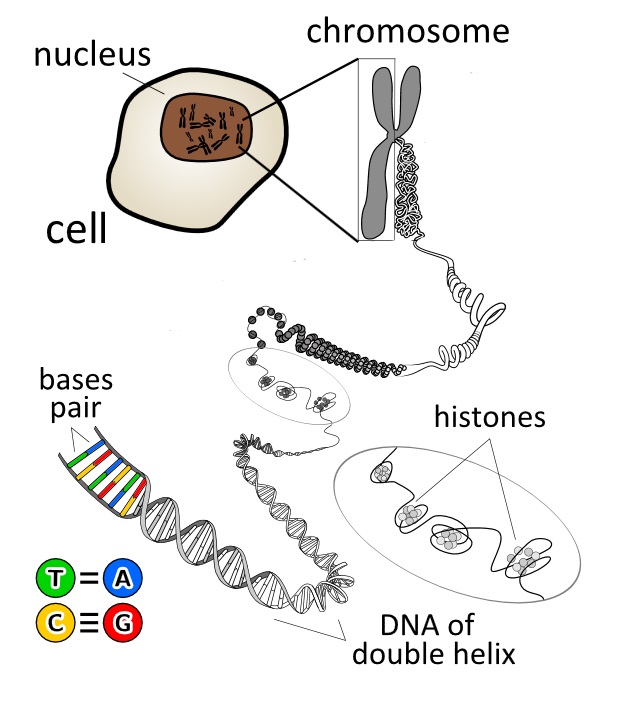
Before we talk about these other factors, it is important to understand a few structural aspects of DNA. DNA exists in cells loosely wrapped around proteins called histones. This looks like beads (histones) on a string (DNA). DNA wraps around histones easily because DNA is negatively charged and histones are positively charged, and oppositely charged things attract one another. (Think about magnets that stick together when the opposite poles are facing each other, but repel each other when the same poles are facing each other.) In order to keep the DNA from wrapping too tightly around the histones, acetyl groups are added to the histones. Acetyl groups cover up the positive charges on the histones. This makes the histones less positively charged so they don’t attract the DNA as strongly. (This would be like making one of the magnets less strong. It is easier to pull apart two magnets that aren’t strongly attracted to each other.)

This diagram of epigenetic mechanisms is by NIH at Wikimedia Commons.

When methyl marks are present on DNA they attract proteins that remove the acetyl groups. This causes the DNA to wrap around the now more positively-charged histones very tightly. (The magnet is stronger now). When a whole section of a gene becomes wound up this tightly it leads to a complete covering up of the “read” or “don’t read” sign. Sometimes this can also happen on part of the gene that would normally be read (the actual page of the instruction manual). If enough of the gene is covered up by the DNA wrapping too tightly around the histones, then the gene cannot be read (imagine if there was a large object covering the page you wanted to read in the instruction manual).

Once a “read” or “don’t read” sign is covered up, it is not necessarily covered up for the rest of your life. Instead, the environment can remove methyl marks from DNA and add acetyl groups back onto the histones (covering up the positive charge on the histones, making them attract the DNA less strongly). This would uncover the sign and allow it to be read once more.

All of this means that traits (including behavior) may be influenced by both genes and the environment. Although the genes we are born with only make it possible for us to express certain traits, our environment helps determine which of those traits are actually expressed. If our environment changes, the traits we express can change! Because we can change our environments, we have the power to change ourselves!

Monday, June 6, 2016

Love, War and Genital Shape

The size and shape of your junk may depend on how much sex your ancestors had… that is, at least, if you are a burying beetle.

Buring beetles caught in the act. Photo by Jena Johnson.

Burying beetles are unusual among insects in that they provide parental care and are often monogamous. When burying beetle pairs find a small dead bird or rodent, they pluck it bald, coat it in antibacterial and antifungal body secretions, and dig a hole around it. The female lays her eggs around the carcass-ball, so that their newly hatched babies can feast on it, as well as additional food that the devoted the parents bring them. In this system, mothers are capable of taking care of their babies by themselves, but they do better if fathers stick around. This has led to sexual conflict in these species: after mating, many males will climb to a high perch to release pheromones to attract additional females… but if his partner catches him, she’ll knock him off his perch.

A nurturing burying beetle mom feeding her young. Photo by Paul Hopwood.

Male and female burying beetles also differ over how much sex to have. Males are better off when they have lots of sex, because this increases their chances of fathering more young. However, females are better off when they have less sex, because they don’t need a lot of sex to fertilize their eggs and too much sex reduces their ability to provide maternal care. In this battle of the sexes, genitals can become a specialized weapon.

A research team from the University of Exeter in the United Kingdom, including Paul Hopwood, Megan Head, Eleanor Jordan, Mauricio Carter, Emma Davey, Allen Moore, and Nick Royle, hypothesized that selectively breeding burying beetles who have more or less sex could lead to changes in genital structures over multiple generations. They randomly assigned burying beetles a monogamous partner and measured how much sex they had. They then bred the offspring of the high-sex parents together to create high-sex genetic lines, they bred the offspring of the low-sex parents together to create low-sex genetic lines, and they bred offspring from random parents together to create control genetic lines. They continued these high-sex, low-sex and control lines for ten generations. They then measured and compared the genitals of these 10th generation offspring.

Porno pictures of burying beetle genitals. Images A and B are male genitals from the top and side views. Images C and D are female genitals from the top and bottom views. The blue and pink dots are the landmarks the researchers used for measuring genital size and shape. Image from the Hopwood et al. 2016 paper in Evolution.

The selective breeding program changed genital shape in both males and females after only ten generations. Males from the high-sex genetic lines had longer and straighter penis-like structures with shorter sensory hairs, whereas males from the low-sex genetic lines had shorter penis-like structures with longer sensory hairs. Perhaps these long sword-like penis-like structures help males overcome females that resist male sexual advances by wrestling, kicking and curling their abdomens away. Females, on the other hand, had shorter vulvas and thicker genital claws (yes, these girls have developed genital claws for this sex war) in both the high-sex and the low-sex genetic lines compared to the control genetic lines. Furthermore, the genetic lines in which males developed longer penis-like structures had females that developed more narrow-set genital claws, showing that these traits were changing together from generation to generation.

There is a tremendous diversity of genital shapes across the animal kingdom. We often think of this genital diversity as coming from the compatibility of the sexes, like a lock and key, when the truth is that love is a battlefield and genitals are weapons of war.


Want to know more? Check this out:

Hopwood, P., Head, M., Jordan, E., Carter, M., Davey, E., Moore, A., & Royle, N. (2016). Selection on an antagonistic behavioral trait can drive rapid genital coevolution in the burying beetle, Evolution DOI: 10.1111/evo.12938

Monday, March 28, 2016

My Brother's Keeper


Photo by pugphai at freedigitalphotos.net.
Relationships with siblings tend to be complicated. We love them, but they drive us nuts. We want to help them, but not if it takes too long or costs too much. These are common struggles because the psychology of these relationships is in our biological heritage.

Let’s play a thought experiment: Say a runaway trolley is heading down the tracks. Ahead of the trolley are five people tied to the tracks that are about to become mush (Don’t ask why they are tied up on the tracks – Just assume the evil boogeyman got them). You are in the distant train yard next to a lever. If you pull the lever, the trolley will switch to another set of tracks, sparing the lives of the five tied-up people. But… there is one person tied to the other set of tracks, so pulling the lever would also kill that one person. What do you do?


Photo by David Ingham at Wikimedia.

This is the classic scenario in a field of ethics called “trolleyology”. (Yes, this is a thing). If you are like 9 out of 10 people, you chose pretty quickly to kill the one person to save the five. Our utilitarian morals tend to value more lives over fewer.

But what if that one person is your daughter? Your mother? Your brother? The dilemma just became harder, didn’t it? Not because the one life is now inherently worth more than the five… but because that one life is worth more to you.

We are a social species that tends to live in family groups, as were our ancestors for over 100,000 generations. We also share more of our genes with our closest family members through shared inheritance. For example, we each share about half of our alleles (our particular version of a gene) with each of our biological parents. Our siblings with the same two parents have also inherited about half of each parent’s alleles, but not necessarily the same ones that we did. This means that we share about half of our alleles with our full-siblings too (and we share about a quarter of our alleles with our half-siblings). Following this same math, we share about a quarter of our alleles with our aunts and uncles and about an eighth of our alleles with our cousins. The more distant the relative, the fewer alleles we have in common.

Now let’s play another thought experiment: Say there is a population of animals where some individuals have lots of babies and raise their children to be good parents, and other individuals don’t have a lot of babies. An individual that has the “have lots of babies” and “be a good parent” alleles are going to share, on average, half of those alleles with each of their many children. They are also going to have more surviving children than most of the individuals that do not share those alleles. So, over many generations, more individuals in the population are going to have the alleles that make them have more babies and take care of them, right?

But there is another potential outcome to this thought experiment. Yes, we share about half of our alleles with our children, but we also share about half of our alleles with our full-siblings. Therefore, a “take care of your siblings” allele has the same probability of spreading through the population over generations as a “be a good parent” allele.

The genes that predispose our behaviors and decisions have been shaped by the generations of our ancestors that determined which of their relatives would have the support to raise more or fewer children… or none at all. In the 1960s, William Hamilton proposed a mathematical rule (called Hamilton’s Rule) for just such a decision:

rbB > rcC

where B is the number of individuals that survived because of you, rb is a measure of relatedness to those individuals, C is the number of individuals that died without your help, and rc is your relatedness to those individuals. This means that to pass on the most of our genes, we should factor in how many individuals and how closely-related they are to us when we decide who to help and who to sacrifice. 

For example, if you help to raise three of your siblings, each of which share ½ of their alleles with you and who would have died without you, but this means that you can’t take care of your own child that dies as a result, then this equation would be (½) X 3 > (½) X 1. This means that, mathematically, you should opt to raise your three siblings rather than your own child. J.B.S. Haldane, an influential geneticist, summed this decision process up when he was asked if he would give his life to save a drowning brother by responding “No, but I would to save two brothers or eight cousins”.

Inserting our close family members into the hypothetical trolley problem makes us squeamish because it puts the “take care of your family” alleles we have inherited in conflict with our utilitarian morals. We are literally the species we are today because we take care of our brothers and sisters as well as our children… even when they’re obnoxious.

Monday, October 12, 2015

How Fashion Destroyed My Best Friend (A Guest Post)

By Sarah Johanson

“Bulldog Portrait Frank”. Image by Pharaoh Hound at Wikimedia.

Man’s Best Friend is a title that has been passed onto our four-legged, drooling counterpart. Dogs have been at man’s side for a number of years showing us his dedication and protection. In the 19th Century, humans started breeding dogs as a hobby. Today, humans have created more than 400 breeds, with less than 200 being recognized by the American Kennel Club, and all can be traced back to the same canid ancestors similar to the gray wolf. As humans selectively bred dogs based on their physical appearances to make a fashion statement, beneath the skin genetic and physiological changes where happening that would have a far harsher consequence to dogs’ health. One such breed is the English Bulldog.

All dog breeds have what are known as breed standards that are set by the Kennel Club or the American Kennel Club. These standards dictate what the breed should look like physically. At first, dogs were bred on a guideline of form follows function. Bulldogs were bred to help butchers control bulls in the slaughter yard. They had long snouts with strong jaws, necks and shoulder muscles while also being tall, allowing them to be quick and agile. However, during the fashion era of dog breeding in the 19th century, breeding became more of a hobby for physical appeal rather than for the dog to have a purpose… which brought us the bulldog we see today.

Head Comparison of a Bulldog (bottom)
and that of a Labrador Retriever (above).
Bulldog image “Camilla, the english bulldog,”
by Trevomeisel at Wikimedia. Labrador
image and edits done by Sarah Johanson.
Over time, the bulldogs’ upper jaws and snouts have been shortened by a significant amount, giving them those mushed short faces. They were bred this way because people thought they looked cute. This shortening is caused by a genetic mutation which causes a developmental defect during bone formation. It’s thought the defect became prevalent due to severe inbreeding. This shortening of the upper jaw has led to there not being enough space in bulldogs’ mouths. Their tongues and palates are often compressed, with the teeth on their lower jaws protruding out in odd directions as their teeth don’t fit, leading to problems with eating and chewing food.

Bulldog nostrils have also been compressed to the point that they can barely breathe. If a human were to breathe like the bulldog, it would be like breathing through a straw. Having a small airway has led the bulldog to become easily overheated and exercise intolerant. To cool down most dogs pant, using water as a tool to take heat away with it as it evaporates. Due to the soft palates not being able to fit in the dogs’ mouths and the narrowing of their throats, panting interferes with breathing. This leads to the production of foam, which blocks the airways even more, sometimes causing suffocation.

Bulldogs are also unable to mate on their own or give birth successfully. Due to their short, stocky bodies, very wide shoulders and narrow pelvises, most males cannot breed with the female on their own. The female either needs to be attached to a breeding stand which gives her body support in order to bear the male’s weight or she needs to be artificially inseminated. Furthermore, a natural birth is almost impossible as the puppies’ heads are too large to fit through the breed’s narrow pelvis to leave the body. This condition, known as dystocia, causes over 80% of bulldog births to be performed via caesarian section. Almost all bulldog births need some kind of human assistance; otherwise they would risk the life of the mother and her unborn puppies.

Diagram of bulldog body shape demonstrating how the “box head” of the breed cannot fit through
the pelvic bone (triangle) during birth due to size and shape. Image created by Sarah Johanson.

These are only some of the physical challenges bulldogs face, not to mention all of the medical problems that could follow. It has been the selective breeding done by breeders and the breed standards set that have turned this dog from the power it once was to the mess that it is today. The bulldog became a fashion statement and although he continues to want to please his human counterpart, his body cannot keep up with his desire.


Work Cited:

Baldwin Bulldog. “Bulldogs Overheat.” Baldwin Bulldogs, 10 Dec. 2014. Web. 23 Feb. 2015.

Denizet-Lewis, Benoit. “Can the Bulldog Be Saved?”nytimes.com. The New York Times, 22 Nov. 2011. Web. 5 Feb. 2015.

Dog Breed Health. “Bulldog (English Bulldog).” Dog Breed Health, n.d. Web. 6 Feb. 2015.

Dogtime. “A Brief History of Breeding.” Dogtime, 30 May. 2009. Web. 5 Feb. 2015.

Kalmanash, Angela. “The Physiology and Morphology of a Breed StandardDogChannel. DogChannel, 9 June. 2014. Web. 5 Feb. 2015.

Thomson, Keith Stewart. “Marginalia: The Fall and Rise of the English BulldogAmerican Scientist. 84(1996): 220-223. Web. 7 Feb. 2015.

Wednesday, November 20, 2013

What Cetaceans Can Teach Us About Culture

A bottlenose dolphin mother shares her culture with
her offspring. Image by M. Herko at the National
Undersea Research Program (NURP) available
at Wikimedia Commons.
We often think of culture as being food dishes, music, dance, and clothing that are specific to a group of people. But are we the only species that have culture? What is culture exactly and how does it relate to relationships?

Scientifically, culture is behavior that is socially transmitted between individuals and shared within population groups. Culture fundamentally depends on learning, and specifically learning from others. But everyone doesn't learn equally from everyone else. We tend to pick up behaviors more from individuals that we spend more time with than those that we don't. We also tend to spend more time with individuals that we share behaviors with. And we're not the only ones to show these tendencies.


This week at Accumulating Glitches I talk about various ways whales and dolphins share culture and are influenced by it. Check it out here.


And to learn more, check these out:

Cantor, M., & Whitehead, H. (2013). The interplay between social networks and culture: theoretically and among whales and dolphins Philosophical Transactions of the Royal Society B (368), 1-8 DOI: 10.1098/rstb.2012.0340

And learn about how orcas share dialects here.


Wednesday, August 28, 2013

Some City Birds Are Changing Their Tune


European starlings are one of the many bird species changing their songs
 in urban environments. Image by 4028mdk09 at Wikimedia Commons.
The human world population has climbed to over 7.1 billion people and for the first time ever, more than half of us live in an urban area. Urban areas are spreading and more animals are either getting pushed out or are becoming urbanized in the process. Birds are among the many species we are used to seeing and hearing in our cities, but how exactly are they and their songs being affected by urban spread?

This week at Accumulating Glitches I tell the story of how urbanization is changing our avian soundscape. Check it out here.

And to learn more, check this out:

Slabbekoorn, H. (2013). Songs of the city: noise-dependent spectral plasticity in the acoustic phenotype of urban birds Animal Behaviour (85), 1089-1099 DOI: 10.1016/j.anbehav.2013.01.021

Wednesday, August 14, 2013

Epigenetics: The Fusion of Nature and Nurture (A Guest Post)

By Tricia Horvath


For decades scientists have been debating what makes a person who they are. Is someone’s personality, appearance, and medical history determined by their nature (their hardwired genes with the environment playing no role) or nurturing (how they were raised, and what they encountered in their environment growing up)? Many scientists were convinced that only one of these things, nature or nurture, could be responsible for determining a person’s fate. For instance, those who believed in nurture as the prevailing force thought that a person’s specific genes had nothing to do with how they behaved. Although ample evidence has been built up on both sides, scientists now know that the answer is actually both!

If you need convincing, just think about identical twins. Identical twins are genetic clones (all of their genes are exactly the same). These twins are very similar to each other in many ways such as physical appearance and personalities, even if they are separated at birth and raised apart from one another. However, anyone who has spent significant time with identical twins knows that each twin is their own person, and as they get older and spend less time together the personalities of the twins will continue to diverge. If nature (just genes) was in charge, identical twins would be the same in every respect. If nurture (just environment) was in charge, identical twins would be no more similar than any pair of siblings.

Genes are like pages in an
instruction manual for ourselves.
If genes are the pages in our
instruction manual, then DNA
is the actual book. Image by
tungphoto at freedigitalfotos.net.
So how is any of this possible? The answer lies in a field called epigenetics. Epigenetics studies how the environment interacts with genes to change their expression. Genes are like pages in an instruction manual for ourselves. In order for certain traits to be expressed, these genes/pages need to be read. If a gene cannot be read, then the trait it represents will not be expressed.

The environment plays a large role in determining which genes can be read, and therefore what traits are expressed. However, if a person does not have the genes for a specific trait (their book does not have those pages) that trait could never be expressed. For example, no matter how much time you spend in the water growing up, you will never grow a mermaid tail because you don’t have the genes for a mermaid tail. In this example, spending a lot of time in the water growing up would be part of your nurturing, and the lack of genes for a mermaid tail would be part of your nature. Even though having a mermaid tail would be beneficial in the water, the environment cannot interact with your genes to give you a mermaid tail because you simply don’t have the genes. Therefore epigenetics only works if you have the right genes.


How does epigenetics work?

DNA is the long strings of genetic material that are found in every cell (and every cell has exactly the same DNA). Genes are strung together on the DNA strings: If genes are the pages in our instruction manual, then DNA is the actual book. Each gene has a section with “read” or “don’t read” signs. The gene will be read, or not read depending on which of these signs is showing. The environment can determine which genes are read (and therefore which traits are expressed) by covering up these signs.
You’re less likely to stop if you don’t see the sign.
Photo by Nicholas A. Tonelli at Flickr.

The first player in covering up one of these signs is a methyl mark. Methyl marks are little chemical tags that get attached to certain parts of DNA. Methyl marks have two jobs. First, they partially cover up one of the signs (“read” or “don’t read”). Second, they help attract proteins that can help completely cover up the sign.

Before we talk about these other factors, it is important to understand a few structural aspects of DNA. DNA exists in cells loosely wrapped around proteins called histones. This looks like beads (histones) on a string (DNA). DNA wraps around histones easily because DNA is negatively charged and histones are positively charged, and oppositely charged things attract one another. (Think about magnets that stick together when the opposite poles are facing each other, but repel each other when the same poles are facing each other.) In order to keep the DNA from wrapping too tightly around the histones, acetyl groups are added to the histones. Acetyl groups cover up the positive charges on the histones. This makes the histones less positively charged so they don’t attract the DNA as strongly. (This would be like making one of the magnets less strong. It is easier to pull apart two magnets that aren’t strongly attracted to each other.)

This diagram of epigenetic mechanisms is by NIH at Wikimedia Commons.

When methyl marks are present on DNA they attract proteins that remove the acetyl groups. This causes the DNA to wrap around the now more positively-charged histones very tightly. (The magnet is stronger now). When a whole section of a gene becomes wound up this tightly it leads to a complete covering up of the “read” or “don’t read” sign. Sometimes this can also happen on part of the gene that would normally be read (the actual page of the instruction manual). If enough of the gene is covered up by the DNA wrapping too tightly around the histones, then the gene cannot be read (imagine if there was a large object covering the page you wanted to read in the instruction manual).

Once a “read” or “don’t read” sign is covered up, it is not necessarily covered up for the rest of your life. Instead, the environment can remove methyl marks from DNA and add acetyl groups back onto the histones (covering up the positive charge on the histones, making them attract the DNA less strongly). This would uncover the sign and allow it to be read once more.

All of this means that traits (including behavior) may be influenced by both genes and the environment. Although the genes we are born with only make it possible for us to express certain traits, our environment helps determine which of those traits are actually expressed. If our environment changes, the traits we express can change! Because we can change our environments, we have the power to change ourselves!

Wednesday, June 19, 2013

Thanks Dad!

Daddy's girl. Photo from freedigitalphotos.net.
Let’s take a moment to appreciate just how special dads are. Across the animal kingdom, fathers caring for their young is the exception, not the rule. Paternal care is most often seen in species in which males can be pretty sure that they are indeed the father (for example, in species that fertilize eggs outside of the mothers’ bodies or in socially monogamous species). Mammals rarely act fatherly - Only 10% of mammalian species show paternal care at all. But among mammals, primates (including ourselves) are more likely to do so.

Dads do a number of things to care for their young: Depending on the species (and the individual), they may incubate them, provide them with food, groom them, keep them close to home, guard and protect them, and help them gain survival and mate-attraction skills. These behaviors are costly to a male, who could often be reproductively more successful by spending his time and resources courting more females. But they do it nonetheless.

Regardless of whether a dad is behaviorally involved with his offspring, he contributes a fair amount to the individuals we grow up to be. Dads provide nearly half of our genes, which are the instructions for the production of all of our bodies’ tissues and chemicals. These tissues and chemicals don’t just make up our physical bodies, they underlie much of our physical abilities, susceptibilities to disease, and behavior patterns (including personalities).

Just because about half of your genes are from dad and about half of your genes are from mom, doesn’t mean that you are strictly half-your-dad and half-your-mom. Imagine you are given two books of Thanksgiving Day recipes: Both books have the same recipe for turkey, so that is the one you are going to follow. But one book has a recipe for garlic mashed potatoes and the other has a recipe for plain mashed potatoes. If no one in your family likes garlic, you will likely follow the recipe for plain potatoes. In addition to choosing between recipes, you can also combine them: If one book has a recipe for stuffing with lots of garlic and onions and the other has a recipe for stuffing without garlic or onions, you could make stuffing with onions and no garlic. Your pairs of genes work in similar ways: if the two copies of a gene are different, you may get the trait of one of them or they could combine to give you an intermediate trait. If the versions of the gene are the same, you will likely just get that trait.

When something is made by following the instructions in a gene, this process is called gene expression. Not all genes are expressed equally everywhere: All of the cells of our body have the same genes, but the way they express in a particular cell determines whether that cell is part of a lung, a heart, a brain or something else. If for a particular gene the instructions in the gene from one parent are followed and the gene from the other parent is ignored, this is called parent-specific gene expression. We have several traits that occur as a result of dad-specific gene expression.


Your genes are lined up on doubled-stranded DNA, which is tightly coiled around proteins called histones. The DNA is then wrapped even more and packed into chromosomes. You have 23 different pairs of chromosomes in each cell, where one of each pair came from mom and the other came from dad.  Figure adapted from an image by KES47 at Wikimedia.
More variation is caused by the fact that two individuals with identical genes may not have identical traits. Our genes are encoded in strings of DNA, which are coiled around proteins called histones and then packed into chromosomes. Biological factors can cause the string of DNA to coil tightly around these histones, hindering access to any genes in that section of DNA. This reduces or even prevents gene expression from happening (Imagine what would happen if two pages of your Thanksgiving Day recipe book stuck together). Alternatively, other biological factors can relax the DNA string, increasing gene expression. Gene expression is often decreased or increased as a result of life experiences (such as social experiences, nutrition, or exposure to drugs and toxins). If a particular gene is decreased or increased this way in a sperm or egg cell, this effect can be passed on to the children (and often grandchildren and great-grandchildren and so on). This process of inheritance that is not a strict passing on of genes is called epigenetics. Epigenetics is a new and emerging field, but we have already learned that mothers that provide more parental care create lasting changes in their offspring that are passed down for multiple generations. It is likely that fatherly care has a similar effect. We also know that a father’s nutrition and exposure to drugs and toxins can pass several traits down the generational line through epigenetics.

Dads play a special role in the individuals we become. Their behavior with us, genetic makeup, and even personal experiences shape our physical appearances, health, abilities and personalities. If you haven’t yet, take a minute to say “Thanks, Dad!”

Happy (late) Father’s Day, Dad!


Want to know more? Check these out:

1. Curley, J., Mashoodh, R., & Champagne, F. (2011). Epigenetics and the origins of paternal effects Hormones and Behavior, 59 (3), 306-314 DOI: 10.1016/j.yhbeh.2010.06.018

2. Wilkins, J., & Haig, D. (2003). What good is genomic imprinting: the function of parent-specific gene expression Nature Reviews Genetics, 4 (5), 359-368 DOI: 10.1038/nrg1062


And a special thanks to Tony Auger, Cathy Auger, Stacey Kigar, and Robin Forbes-Lorman for their feedback.

Wednesday, May 8, 2013

Thanks Mom!

Like Mother, like baby!
Photo from freedigitalphotos.net.
Moms give us so much more than we ever give them credit for. Biologically speaking, we all have a mom and a dad (unless you’re a flatworm or some other species that can reproduce without sex) that provide us with one of each chromosome type (our chromosomes contain our genes, commonly thought of as our “biological blueprints”). So it makes sense that we tend to think of ourselves as being half-our-mom and half-our-dad. But not so! All of us are slightly more-our-mom and slightly less-our dad.

Our genes are encoded in our DNA, which is coiled and tightly packed into dense little chromosomes. Most of our cells contain 23 different pairs of chromosomes (for a total of 46), and one from each pair comes from each parent. One of those pairs is the sex chromosomes. Individuals with two X sex chromosomes are genetically females and individuals with an X and a Y sex chromosome are genetically male. Because genetic males are the only ones with Y chromosomes, all Y chromosomes are inherited from dad. But compared to X chromosomes, Y chromosomes are piddly little things that don’t contain as many genes. So if you’re a guy, you already have more genes from mom than from dad.

In addition to our 46 chromosomes that we keep in the nucleus of each cell, we also have a tiny set of genes in another cell structure, the mitochondria. This mitochondrial DNA is only inherited from the mother, so regardless of whether you are XX or XY, you have a few more genes from mom than from dad.

Wait! My genes are where??
Your genes are lined up on the doubled-stranded DNA, which is tightly coiled and packed into
chromosomes. You have 23 different pairs of chromosomes, where one of each pair came from
mom and the other came from dad. A copy of each of these 23 pairs of chromosomes
(46 chromosomes in total) is in the nucleus of every cell you have (except for sperm or egg cells,
which only have one of each pair, or 23 chromosomes in total). Get it?
Figure adapted from an image by KES47 at Wikimedia.

But we are not simply a product of our genes. If we were, identical twins would be, well… identical. But they’re not. The slight differences between twins results from differences in how our environment interacts with our genes. (By environment, I’m not just talking about temperature and air quality, but rather all external influences). Our environment plays a big role in shaping the individuals we become, and our mothers have more effect on our environment than our fathers do. When we are developing in the womb, our moms’ bodies single-handedly provide us with nutrients, hormones, and antibodies (and sometimes pathogens). During this time, her circumstances and decisions will determine what kind of setting we are born into. After we’re born, the social interaction, nutrition, and antibodies (through breast feeding and/or vaccines) she provides will all influence our gene activity and thus how we develop. Collectively, the traits that we develop due to these factors and all mom’s other nongenetic influences are called maternal effects.

Mom gives us more genes, and has more input in determining how active each gene is. In the end, we are who we are in large part because of our moms.

So Mom, this is for you:


Happy (early) Mother’s Day!


Want to know more? Check these out:

1. BERNARDO, J. (1996). Maternal Effects in Animal Ecology Integrative and Comparative Biology, 36 (2), 83-105 DOI: 10.1093/icb/36.2.83

2. Wolf, J., & Wade, M.J. (2009). What are maternal effects (and what are they not)? Phil. Trans. R. Soc. B, 364, 1107-1115